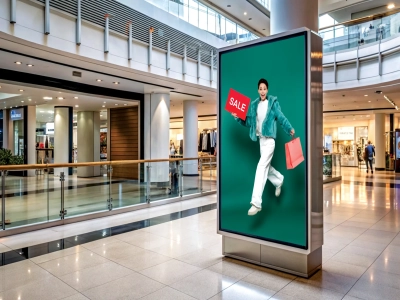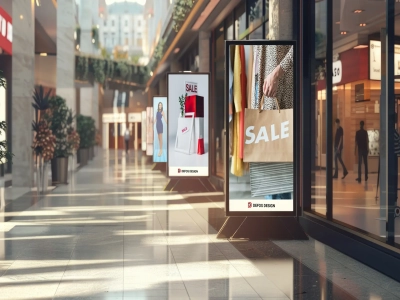

Why do you think some shoppers stand outside a particular store rather than stopping outside some other store?
Why do some shops feel more lively than others?
How are some modern-day stores able to convey their story in mere seconds, while others do not?
The answer to these questions lies in digital signage display. Retail is now in an era where the need for instant communication is at an all-time high. This communication should be adaptable and visually effective. This has given way to the entry of digital signage display, that has completely revolutionised the way businesses talk to their customers.
Long gone are the days when retail was about product display on the shelves. It has come a long way in the form of digital displays, but what exactly is a digital signage display? Let's talk.
When a business makes use of electronic/digital screens to display visual content within a physical spcae, it is known as a digital display. The displayed content can include anything from promotional content, informational, branding or real-time updates. They are a step ahead of the traditional signage that remained static unless replaced manually. They only require a centralised platform that can replace the content within seconds.
A digital sign, in simplest terms, is visual content. It displays different messages at various times of the day, be compatible with seasonal campaigns and remain the same across various setups.
Recent times have seem customer’s attention deteriorating. They want all the information- immediately. In a competitive world full of businesses trying to outshine each other on every platform. It is here that a digital display comes into play. This display helps retailers communicate promptly and effectively with consumers. Moving visuals catch the eye faster than static visuals.
In the year 2026, customers expect to see digital displays in their favourite stores, outlets and even when exploring other shops. Any business not going through the path would seem outdated. Technology has made the world more competitive. From smartphones to public outlets, every place has become smarter.
The presence of a digital screen is directly proportional to how a person reponds. How they move through a store, what products they pay attention to. Visual displays are far more eye catching than the text-heavy content.
For example:
These visual displays help improve customer experience over time.
One of the greatest limitations with static communication is that they bound the retailers to one display for weeks or months. Digital displays, on the other hand, can be replaced with ease. One can change one visual content to another with the blink of an eye.
Brands can easily highlight trending products, services, and offers and rotate them to create a dynamic appeal. This is specially helpful during festivals, different seasons or fast-changing consumer demands. When displayed across all outlets, these displays help create the brand identity.
The initial cost of printed materials might seem to be cheaper, but they often result in recurring expenses- design, printing, shipping and labour. These additional costs can be reduced with the help of digital displays. Once they are installed, content updates can be handled digitally, saving time, efforts and money. This makes the digital sign more flexible, more sustainable.
This is what is happening in the year 2026-
When a buyer witnesses a well-implemented digital display, it leaves a positive impression of innovation and professionalism on him/her. A well-implemented digital display signals innovation and professionalism. This points out that the business is forward thinking and attentive to customers’ requirements. Businesses that delay adoption might find it difficult to compete with stores that remain ahead with modern-day techniques.
There are various formats for digital displays, out of which LED signage stands out for its distinct features- brightness and visual clarity. They work well in malls, stores and areas that require good visibility. Also, they consume less power as compared to other options making them a preferred choice for various businesses.
One of the other applications of LED signage is that they can be installed in small spaces as well as large areas, making them a versatile choice for various businesses.
In these modern times, retail spaces are designed to engage consumers. Digital displays set the tone, aisle displays inform customers and support impulse purchases. Some platforms choose a second digital display screen for advertising. This engages and entertains customers with engaging content. These small efforts can greatly impact customer satisfaction.
|
Factor |
Traditional Communication |
Digital Communication |
|
Content Flexibility |
Fixed once printed |
Easily changeable |
|
Visual Impact |
Static |
Motion-based |
|
Update Speed |
Slow |
Instant |
|
Cost Over Time |
Repetitive expenses |
Long-term savings |
|
Brand Consistency |
Difficult to manage |
Centralized control |
|
Customer Engagement |
Limited |
High |
This table will give you an idea about the basic differences between traditional and a digital retail communication.
Year 2026 asks for adaptability. Physical stores that have not expanded to digital modes should start thinking about that and soon if they want to connect with their audience on a higher level. Nothing can completely replace physical stores, but integrating them with digital mades can make a lot of difference in terms of buyer’s and seller’s connectivity. The aim is not to replace human connections but to accelerate it.
Retail has always been and will always be about connection between the buyer and the seller. But the year 2026 and the upcoming ones will enable retailers to speak in a visual format. All the businesses thinking about shifting their business to a physical mode should do so now.
When state of art technologies like LED walls, LCD monitors and display signages are used to display content, it is known as digital signage.
An LED display of your favourite brand of shoes would be one of the examples of digital signages.
LEDs, LCDs and OLEDs are some of the examples of digital signage equipment.
This is how you use a digital signage display.